Long-awaited rainfall in the Horn of Africa creates a new disaster
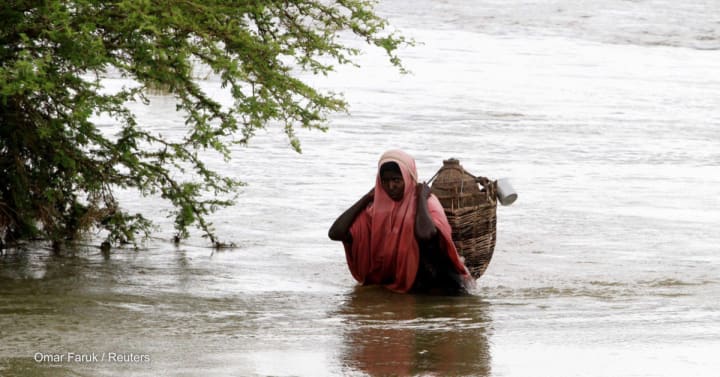
The Horn of Africa experienced one of the longest and most severe droughts on record — six consecutive failed rainy seasons have created the worst drought in the region in 40 years.
And while rains have finally come, they’ve come in excess in some parts of the region — creating a new kind of disaster. Flash flooding caused the banks of the Shabelle River in central Somalia to break, leading to a quarter of a million people fleeing their homes.
There are still 43.3 million people in need of aid — 28.6 million of which are in Ethiopia, 6.4 million in Kenya and 8.25 million in Somalia. Over 23.5 million people are facing high levels of acute food insecurity in the three countries.
Next week, Italy, Qatar, the United Kingdom, and the United States will host a high-level pledging event for the humanitarian response in the Horn of Africa, where they are hoping to get $7 billion for the response.
Over the course of the drought people have fled en masse from rural areas — where they were pastoralists and engaged in agriculture — to displacement camps, which are often in urban areas. People often came to these camps as a last resort after losing everything, including all of their livestock, said Daud Jiran, Somalia country director for Mercy Corps, during a webinar hosted by Mercy Corps and moderated by Devex.
“In a way, the situation now might even be worse than it was a few months back, because it rained for these people, but they have nothing to go back to.”
— Daud Jiran, Somalia country director, Mercy Corps
“The rain is a relief to everyone,” he said, adding that there has been some pasture regeneration in some areas and the temperatures have come down. But it still doesn’t change the overwhelming reality for most people who don’t have the resources to rebuild their lives and are stuck indefinitely in these camps.
“We don't see that people are seeing the rains as an opportunity to go back,” he said. “In a way, the situation now might even be worse than it was a few months back, because it rained for these people, but they have nothing to go back to — and the few [bits of] humanitarian support they were getting will end in the next few months. So what will happen?”
As climate change fuels more erratic weather, there is a call for more funding toward long-term resilience programming that is aimed at helping equip people to endure climatic shocks and recover from them.
“It will take a very long time to rebuild the lost livelihoods and assets,” Mohamed Abdikadir, executive director of the Organization for Welfare and Development in Action.
He added that the development and humanitarian partners need to work more coherently together which includes “complementing and integrating different funding instruments.” He also called for development partners to have contingency funding that is specifically earmarked for emergencies and that local partners co-design solutions with international organizations.
During the webinar, Jeeyon Kim, senior researcher with Mercy Corps, highlighted some successes in the Horn of Africa, as well as forthcoming research.
In Somalia, for example, research has shown that access to credit and loans — especially through Village Savings and Loans Associations, Self Help Groups, and other local savings groups — are a critical source for survival in crises and are consistently linked to better food security and well-being outcomes, she said.
And while the vast majority of humanitarian assistance in the Horn focuses on direct support like cash, food, water, and nutritional assistance, she said, “It is equally important that the response supports the systems that help communities cope with and recover from crises.” This includes social systems such as formal and informal social protection systems, community networks, and informal institutions as well as market systems.
She said that a market-led drought response can include multi-purpose cash assistance and nutrition social behavior change, vouchers for livestock inputs, commercial destocking — which includes programs to purchase livestock from pastoralists during the early stages of a slow onset crisis, water system repair, and improved water governance.
Research has shown that “these market-based humanitarian interventions helped households avoid selling off livestock at inopportune times and maintain their assets and health during the height of the drought,” she said.
The speakers also called for anticipatory action — asking that funders respond to early warnings about slow-onset disasters, and said that aid partners have largely failed to respond to underlying drivers of fragility, including conflict and climate change.
“Climate adaptation programs are rarely financed in fragile states, and those which are, are not delivered in a conflict sensitive manner in the Horn as well as the Sahel,” Kim said.