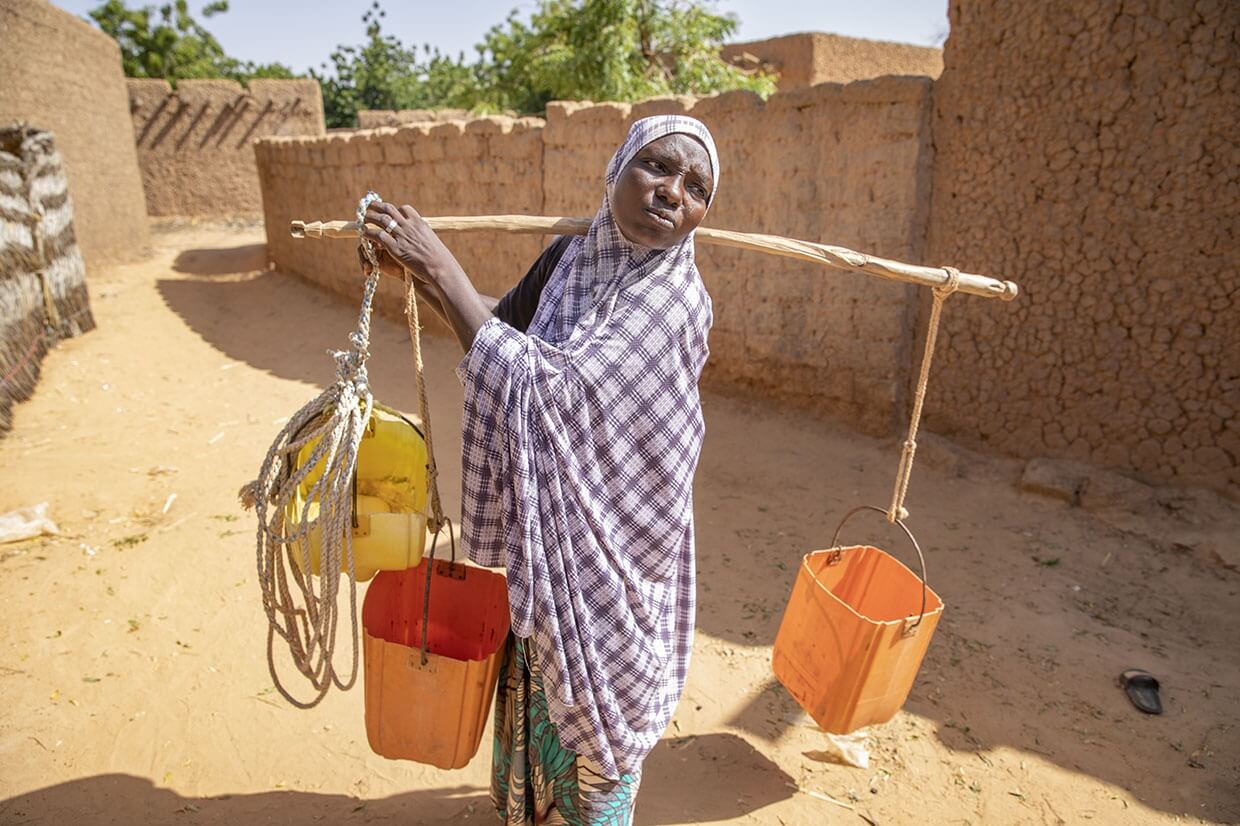
Niger

Mercy Corps has been working in Niger since 2005 to help communities recover from crises, build resilient livelihoods, and strengthen relationships with the government. In 2025, Mercy Corps reached nearly 83,000 people across the country.
The context
Niger is a vast country with a young and rapidly growing population located in the Sahel. It has one of the highest rates of extreme poverty in the world at 43% and is ranked last (189 out of 189) in the UNDP’s 2020 Human Development Index which measures standard of living.
The deteriorating security situation on the borders with Mali, Burkina Faso, and Nigeria is forcing people to flee their homes and significantly increasing humanitarian need. Niger hosts over 230,000 refugees and 300,000 displaced Nigeriens.
The Nigerien economy, which is barely industrialized and highly import-dependent, lacks the development and refinement needed to provide for its own needs, particularly food. Additionally, the lack of education and employment opportunities contribute to Nigeriens, primarily men, deciding to participate in seasonal migration within Niger and the wider region, despite the risks involved.
The majority of people in Niger—around 80% of working adults—make their living in the agro-pastoral sector, which is suffering at the hands of climate-related stressors. The increasing severity of climate change is heavily impacting the people of Niger, their livelihoods, and overall quality of life. In 2020 alone, 550,000 people were impacted by floods and millions more have been impacted by droughts.
Irregular rainfall, poor agriculture practices, and degraded land combined with high population growth and security constraints are impacting crop yields and causing regular food shortages and rampant malnutrition. It is estimated that 1.7 million Nigeriens require food assistance. This number is likely to increase to 2.3 million during the lean season in the summer. Reduced income and increased prices due to the COVID‑19-related economic downturn has also impacted people’s ability to purchase food when it is available.
-
3.8m
-
1.7m
-
25%
In addition to environmental challenges, low levels of education and gender inequalities pose a serious challenge to development. Niger has the highest child marriage rate in the world. One out of every four girls in Niger marries by the time she turns 15, and three out of every four marry by the age of 18. Many of these girls have had limited or no opportunities for education and will have, on average, seven children—the highest fertility rate in the world. Once married, there is pressure to have children even though girls’ bodies are not ready to bear children, risking the health of the mothers and babies. Mother’s lack of education also affects their ability to provide nutritional meals to their children.
Our impact
Mercy Corps has been working in Niger since 2005, first responding to the severe hunger crisis and now helping communities become more resilient to future crises. Our work is focused on:
- Meeting humanitarian needs
- Increasing food security and improving agriculture practices
- Diversifying and creating new economic opportunities
- Building the agency of young women and girls
- Fostering peace and social cohesion
As Niger continues to face the COVID‑19 pandemic, we are taking the necessary precautions so we are able to continue supporting communities safely. We are also sharing prevention messages as part of all our programs.
Meeting humanitarian needs
Mercy Corps helps communities prepare for and recover from crises. We support crisis-affected communities to build more resilient and safe livelihoods so they can overcome challenges and bounce back quicker.
After a disaster strikes, we respond to address urgent needs while also looking at long-term recovery efforts. Depending on the needs, we will often provide clean water, sanitation facilities, hygiene awareness, and psychosocial support.

Increasing food security and improving agriculture practices
Mercy Corps provides emergency food vouchers, commodities, and cash in times of urgent need while also working to improve long-term agricultural productivity and livestock management. We help farmers adapt agricultural practices and adopt technologies that are more resilient to climate change like conserving water and soil, maintaining and fertilizing crops, and using improved seeds. We connect farmers to climate information services to ensure that they have the necessary data to make decisions. Looking at the broader system, we facilitate connections between producers, wholesalers, and food processors to help expand farmers’ access to markets and increase their income.
Lastly, to improve community health and support nutrition, we are constructing latrines, promoting hygiene awareness, ensuring access to clean water, and disseminating nutritional information through trusted local leaders.


Diversifying and creating new economic opportunities
Mercy Corps supports people, particularly women and youth, to achieve more stable and diversified livelihoods. We partner with the private sector and government to provide vocational training and apprenticeship opportunities in urban and rural areas as well as increase access to and knowledge about savings, credit, and other basic financial services. We are also increasing access to renewable energy alternatives such as liquefied gas and small-scale solar power solutions, saving time and money that can be invested in other activities.

Building the agency of young women and girls
We place a particular emphasis on creating conditions that enable women and girls to thrive. We work at both the community and national levels to influence behavior change and to advocate for new laws.
We provide psychosocial support, share hygiene and nutrition information, and help connect out-of-school girls to educational opportunities. We also help women and girls gain skills and access financial services so they have more opportunities to earn an income.


Fostering peace and social cohesion
We strengthen governance systems at local, regional, and national levels by training leaders and developing systems for inclusion, accountability, and dialogue. We also promote civic engagement so citizens are equipped with the skills needed to engage with the government to express their grievances.
At a community level, we build upon traditional approaches to mediation and conflict prevention and management, while strengthening and making them more inclusive. We promote equality, dialogue, and understanding between ethnicities, genders, generations, religions, and nationalities.