Jordan
An arid nation grapples with water scarcity, the needs of the most vulnerable and the flood of Iraqi refugees.
Latest News
Posted October 27, 2009
Youth in Jordan Promote Cultural Heritage
Country: Jordan
Topics: Youth
“Foundations for a Strong Future: Youth in Jordan and Lebanon Promote Cultural Heritage” is a project implemented by Mercy Corps Jordan and Lebanon. The project is funded by the European Union in the framework of the Euromed Heritage Programme and managed by Mercy Corps. In Jordan, Mercy Corps is implementing this project in partnership with local organizations: The Jordan Museum and Princess Basma Youth Resource Centre (PBYRC).
The project is being implemented in six governorates that include Ma'an, Aqaba, Zarqa, Salt, Irbid and Amman over a 24 months duration (January 2009 to December 2010).
During the first year of the project, 72 youth ages 13-18, were chosen to participate in the activities of this project to gain the sufficient experience to build their capacities and acquire new skills needed to represent cultural heritage. The youth received training on multimedia usage and produced 26 different projects that include films, documentaries, photographs, audio recordings and publications. The projects are currently displayed at local exhibitions in the 6 governorates to highlight the youth's work, and to emphasize the value of diversity of cultural heritage in each community.
The youth projects will then be exhibited at the Jordan Museum. Where, two festivals will be conducted during the two year project duration. In 2009, the festival is going to take place on December 3rd through the 6th and will bring in artisans from around the country to demonstrate crafts that are particular to their regions, such as wood carving, glass-blowing, marble work, or metal work, as a means of demonstrating the diversity of Jordan, its people and its geography. In addition to traditional music, dance, food, and other aspects of cultural heritage such as traditional dress. Mercy Corps will also work with the Jordan Museum to organize training for 25 tour guides on interactive guiding techniques.
Mercy Corps will also produce a Multi-lingual Cultural Heritage Toolkit for educators, local NGOs, and students, in addition to conducting outreach campaigns to schools and youth clubs to introduce the Toolkit. Mercy Corps will also work on building a central website that is linked to both museums in Jordan and Lebanon and will create permanent, multimedia cultural heritage learning towers within the Jordan Museum.
Blog Post: Posted September 17, 2009, 4:36 pm by Gretchen Ansorge
Jordan's Queen visits Mercy Corps disability-rights project
Country: Jordan
Jordan's Queen Rania recently visited a school where we're helping mainstream children with disabilities.
Her Majesty's visit, which was featured in the Jordan Times, was intended to highlight "the importance of integrating children with special learning needs."
In Balama, the Queen visited a kindergarten classroom where the Mercy Corps Programme "Towards Integration for Disabled Children and Youth" successfully integrated five physically disabled students within a regular classroom.
To date, the structural modifications carried out on local kindergarten schools in different governorates have benefited more than 160 students, enabling at least 40 disabled children to learn and interact with their peers in a challenging integrated setting.
Read the whole article here.
Video: Posted September 16, 2008 by Jacob Colie
Iraqi Refugees Learn to Help Each Other
Country: Jordan
Video: Posted September 16, 2008 by Jacob Colie
Empowering Women in Their Communities
Country: Jordan
Topics: Women's Empowerment, Economic Development
Posted November 8, 2007 by Joy Portella
Helping Iraqi Refugees
Country: Jordan
Amman, Jordan — Few items furnished the cramped apartment, one of hundreds like it in one of this city's poorer districts: a tattered rug, an old couch, a mattress in the corner and a small fan to relieve the 100-degree heat.
Inside, a 43-year-old Iraqi woman wept as she told visitors her story. She is a Sunni Muslim with a master's degree who until last year lived in Baghdad with her husband, a Shiite. But they divorced and he threatened to expose her and her daughters, aged six and 10, as Sunni — a disclosure fraught with mortal danger in post-Saddam Iraq.
So, in June 2006, she took her daughters and fled to Amman. A 56-year-old cousin followed six months later, after her own husband was murdered. Here, both are jobless — refugees in Jordan can't obtain legal employment — and depend on the charity of relatives still in Iraq to survive.
As many as one million Iraqis have fled to Jordan since 2003, part of what the UN High Commissioner for Refugees calls "the biggest displacement crisis in the Middle East" in nearly 60 years. Most arrive with little more than the clothes on their backs. The Jordanian people, in keeping with traditions of Arab hospitality, have welcomed fleeing Iraqis — but this small, resource-scarce country is straining to meet their needs.
Most Iraqis in Jordan are not legal residents, and cannot seek formal employment or access government services. With support from the UN High Commissioner for Refugees, Mercy Corps is feeding hundreds of impoverished families through our local partner, Tkiyet Um Ali.
In September, 523 families received a month's worth of dry food delivered to their homes. During the month of Ramadan, which ended October 13, three Iftar tents serving hot meals welcomed an estimated 150 to 200 Iraqis a day. A soup kitchen in Amman serves roughly 300 a day, most of whom are Iraqi refugees.
Staff from Mercy Corps and our two partner organizations visited the Iraqi mother of two during home visits to assess whether or not refugee families qualified to receive the monthly food packages. They conducted in-depth interviews of more than 700 families, asking questions about rent and dependents, touring people's homes to get a sense of their living conditions, and calculating their incomes, most of which came from family remittances.
It's just one of several Mercy Corps programs designed to help the most vulnerable Iraqi refugees — along with their impoverished Jordanian neighbors — improve their quality of life. In the last several months, Mercy Corps purchased equipment for 100 Iraqis and Jordanians with disabilities and organized four peer-support meetings.
We've also assisted Iraqi families in registering their children for formal schooling and helped Iraqis gain access to neighborhood social services like psychosocial counseling, youth activities and job-skills training. The agency recently forged an agreement with an operator of three community centers in East Amman to extend their services to 300 Iraqi families living nearby.
Health and education are the two top immediate concerns for Iraqi families here, according to a recent survey of 372 Iraqis in Amman conducted in conjunction with Community Development Centre-Sweileh. Their longer-term future is uncertain. Very few want to go back to Iraq in its current situation or stay in Jordan; the vast majority has applied for resettlement outside the region, in countries such as Sweden, Australia and Germany.
Until those requests are fulfilled, Mercy Corps will continue to work with the UN High Commissioner for Refugees and the U.S. State Department's Bureau of Populations, Refugees and Migration in providing informal and non-formal education services to meet their basic needs.
You can support Iraqi families — and families from other conflict-scarred areas — by purchasing a Peace Kit today. You can also click here to read a recent publication about the unmet needs of displaced Iraqi families.
Posted October 15, 2007 by Kelsey Noonan
Transition to Education
Country: Jordan
Amman, Jordan — Smiles spread from ear to ear as the school-age girls called for the attention of their friends. For several hours, they frolicked on the playsets in the Zara Youth Park, a quiet greenspace set in a comfortable Amman neighborhood.
For two days in August, Iraqi boys and girls shared the playground with their Jordanian neighbors in a Mercy Corps-sponsored activity designed to help Iraqi children to their new home and to defuse tensions between refugees and their host communities.
"If you take children out of a situation and put them in a different, brighter one, there is a mental release, even for just one day," said Mahmoud, who directed the day's events on behalf of Mercy Corps' partner agency, the Jordan Hashemite Fund for Human Development/Queen Zein Al-Sharaf Institute for Development (JOHUD/ZENID). Most of the Iraqi children, he noted, had witnessed violence and suffered from severe psychological stress.
Activities like the one at Zara Youth Park are part of larger Mercy Corps effort — aided by Jordan's largest nonprofit — to prepare 4,000 Iraqi kids to either attend Jordanian schools or to master academic and life skills through a non-formal educational curriculum.
An influx of refugees
As many as one million Iraqis are believed to have fled across the border to Jordan, part of what the UN High Commissioner for Refugees calls the Middle East's biggest displacement crisis in nearly 60 years. Without legal residency, adults are unable to work, children have inconsistent access to education, and whole families face the constant strain of poverty, isolation and fear. As a result, many rarely leave their homes, and children have few opportunities for positive interaction with their friends.
Although Jordan recently began to allow Iraqi children to register for school regardless of residency status, several factors dampen Iraqi attendance, including fear among Iraqi families of drawing attention to their illegal residency status; intolerance of Iraqi children in schools; and overcrowded and poorly functioning schools in the poorer areas of Amman, where most vulnerable Iraqis are clustered.
In July, Mercy Corps launched a program to improve the welfare of the most vulnerable Iraqi school-age children in partnership JOHUD/ZENID, an experienced provider of formal and informal educational offerings. Funding for the project comes from the U.S. State Department. The work involves academic and psychosocial assessments, counseling, recreation activities, parental-engagement initiatives and a non-formal education program using a curriculum designed by Questscope, a British NGO, that's provided an alternative to Jordanian school drop-outs since 2004.
Both partners currently work with the Ministry of Education to link their non-formal educational programs to certified grade-level certificates and the overall educational goals of Jordan.
A day in the park
Organizing safe places for Iraqi and Jordanian children to play and fraternize is an important component. On August 1 and 2, roughly three dozen Iraqi and Jordanian children — boys on the first day, girls on the second — were given the opportunity to interact and play together in a constructive environment. A morning in the park, followed by a picnic lunch and more play at a children's entertainment center in a nearby mall seemed to set everyone at ease.
"I like to play in the area near my house," said one 10-year old Iraqi boy, "but I don't go out because the children in the neighborhood don't like me and my brother Akram. I don't know why."
No tension existed at the August event; two Jordanian boys said they hoped it would happen again. "I like the Iraqi children and I think they are more behaved than some of the Jordanian kids that I know," said one 14-year-old. "We had a good time today and I would like to see some of the kids again soon."
One girl, Saba, said with a shy smile that she hadn't been to school in two years. Her father was kidnapped in Iraq, and was returned only after his captors were paid ransom. "I am very happy today… this is the best day in a long time," she said. "It's pretty here, and it's so nice just to be playing together. I'm very happy."
Posted September 14, 2007 by Sa'ed Shannak
Saving Water in an Arid Paradise
Country: Jordan
Topics: Water/Sanitation
'Ein Jenna, Jordan — The name of this village means "Spring of Paradise" in Arabic. It's a moniker that belies one of the main challenges facing this and countless other Jordanian communities: the scarcity of water.
Jordan has one of the world's lowest levels of water resource availability per person, according to the World Health Organization. Over the next two decades, a growing population, a fractious regional political context and climate change is expected to exacerbate water shortages in this mostly arid country.
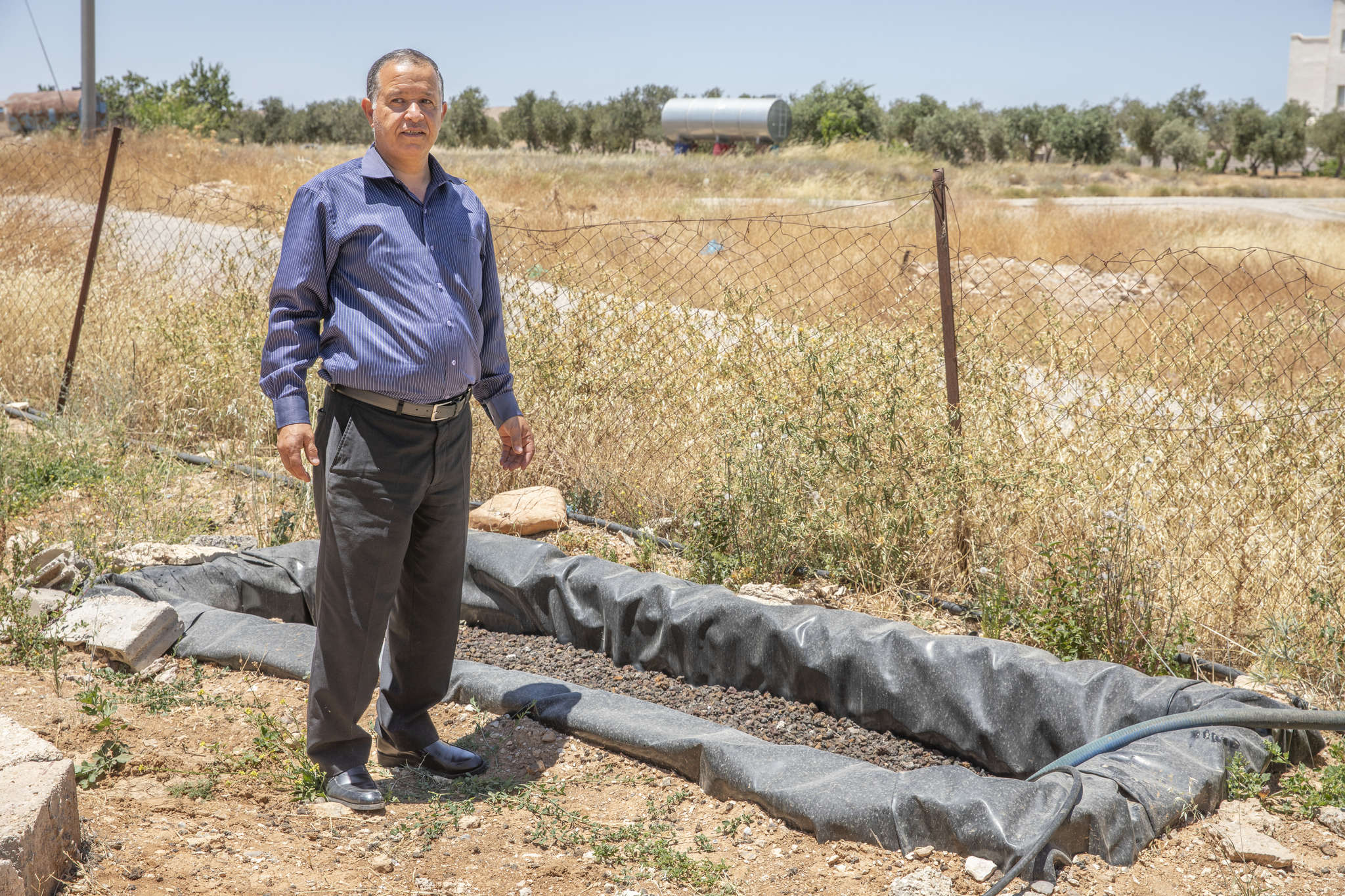
Mercy Corps is responding throughout Jordan by awarding grants to community-based organizations (CBOs) that agree to use the money as a revolving loan fund for household water-conservation projects. Projects include switching to more effective irrigation techniques, installing rainwater havesting cisterns to store drinking water, and helping sheep and goat breeders quench their animals' thirst without wasting water.
Over the project's five-year lifespan, at least 120 rural CBOs will receive grants of 7,000 Jordanian Dinars, or about U.S. $10,000. The project is funded by USAID and Mercy Corps.
Mercy Corps has two local partners in the project: the Jordan River Foundation, a well-respected local civic organization, handles training and shares field supervision responsibilities with Mercy Corps; the Royal Scientific Society, the largest applied research institution and technical service provider in Jordan, provides technical training and a range of technical assistance to the recipient CBOs.
In 'Ein Jenna, Mercy Corps awarded a grant to the Fatmah Al-Zahra Cooperative Society for Women, who in turn loaned that money to nine households who met income guidelines and other criteria. Ghada Al-Qudah founded the organization in 1990 to improve the social, economical, cultural and health conditions for rural women in 'Ein Janna.
"At the time, poverty and unemployment rates in Jordan were rising. Women, especially, needed more employment opportunities," says Ghada. Starting with 500 Jordanian Dinars (about U.S. $700), she and two other women from her village began selling sandwiches to schools. Today, her organization operates a 60-student kindergarten and a sewing crafts business.
After the Society won the Mercy Corps grant, members held meetings in each community to explain the process of the project loans and what they are for. All loans are revolving, which means that once they're repaid, they'll be redistributed as loans for other families, Ghada said.
"We are getting many benefits from this project: we are building our administrative and technical abilities, we're expanding our networks in the community, and we're now more involved in the development activities run by the governate and the kingdom."
'Ein Janna is part of a the governorate of Aljoun, the capital of which features a 12th-century hilltop castle built by the Muslim population to repel the invading Crusaders. Despite its erstwhile role as a strategic outpost, the village is far from wealthy. Most of its families live on monthly fixed incomes of between $225 and $450 - not enough to afford capital expenses associated with water-harvesting projects such as cisterns or reservoirs.
These and other water-conservation efforts are now keeping this spring of paradise from draining its most precious resource. Within six months of completing the cisterns, families saved more than 70 cubic meters of water — or roughly 18,500 U.S. gallons. Money they're no longer spending on water bills, Ghada says, is now freed up for other essential needs.
"We were illiterate in this area," says Ghada. "But now we are one of the fastest to learn."
Posted September 14, 2007 by Marta Colburn
Quenching the Thirst of Goats
Country: Jordan
Topics: Water/Sanitation
Al-Karak, Jordan — Few people know the value of water better than Za'al Al-Kawaleet.
As president of a livestock cooperative in Jordan's central highlands, Za'al has seen the toll that the country's arid environment can take on the sheep and goats he and his fellow cooperative members tend.
For starters, water is scarce. Jordan has one of the world's lowest levels of water resource availability per person, according to the World Health Organization. And the region's rocky, uneven terrain makes it difficult for farmers in Al-Karak to get water to their flocks; much of it sloshes out of open barrels shoved onto the backs of trucks.
"A lot of time, water, and thus money has been wasted working this way," Za'al grumbles.
Water is central to the Al-Karak governate's financial well-being. The economic engine of Za'al's town of Ader is a state-of-the-art dairy that produces cheese and jameed — dense balls of dried yogurt made from goat's milk used in Jordan's national dish of Mansaf. It's said that Al-Karak produces the country's very best jameed. But production, of course, depends on whether herders can quench the thirst of their flocks.
Emran Mayte, one of the livestock cooperative members, adjusts the pipe on an old portable water tank near the village of Ader. Mercy Corps loans are being used to buy new tanks, cutting down on wastage due to old and rusty tanks. Photo: David Snyder for Mercy Corps
Spurred by a Mercy Corps program offering grants for water-conservation efforts, Za'al and his cooperative came up with a way to curtail the spillage that occurs during transport. With 7,000 Jordanian dinars ($10,000 U.S.) from Mercy Corps and USAID, the cooperative purchased ten portable water storage tanks that they now use to bring water to the flocks safely and easily. Farmers that received tanks are repaying the loan on a payment plan, reimbursing the cooperative 850 JD ($1,190 U.S.) over the next 16 months.
The Al-Karak cooperative — whose formal name is the Al-Karak Cooperative for Livestock Raising, Fattening and Marketing — is one of more than 70 community-based organizations (CBOs) receiving grants from Mercy Corps. Recipient CBOs agree to use the money as a revolving loan fund for water savings and efficiency projects, including household rainwater-harvesting systems and drip-irrigation setups.
Za'al and his fellow herders are already seeing positive results from their project. "Things are getting better," he says with pride. "This summer it's been easier to get water to our flocks. As a result, the health of our livestock has improved."
And so, even in times of scarcity, this age-old livelihood will continue.
Posted March 17, 2006 by Dan Sadowsky
Access Middle East
Country: Jordan
Topics: Civil Society, Disability

Karen Saba, at right, leads Mercy Corps' push to include people with disabilities in all of its Middle East programs. Photo: Courtesy of Karen Saba/Mercy Corps
Karen Saba's assignment for Mercy Corps is daunting in both its aim and its breadth.
She's charged with empowering people with disabilities throughout the Middle East, where generally paternalistic and fatalistic attitudes toward persons with disabilities can stymie equal access to education, public facilities and employment.
"Just getting people to talk about disability is the most important thing we're trying to do," Saba says. She hopes to fuel a dialogue that will eventually transform how people with disabilities view themselves, and how communities view the role of the disabled in the region's development.
Although she talks modestly about her own role in this transformation, Saba's background and style suggest that she's a powerful agent of change in this volatile region of 190 million people.
She is an Egyptian native whose deep disdain for inequality is rooted in her own experience with cerebral palsy, a neuromuscular disorder that slurs her speech and slows her gait. But her affable personality, oft-displayed wit and strong belief in incremental change help her stay grounded in the sometimes frustrating fight for inclusion.
Saba knows very well what she's up against. When she was 11, her family moved to Maryland so she could receive better medical care and have a chance to go to college, land a good job and become self-sufficient — none of which her parents thought was possible for a disabled girl in Egypt.
In 1994, Saba graduated from the University of Maryland with degrees in linguistics and history and delved into the field of disability rights in the Washington, D.C. area. She spent three years as a housing specialist at an independent-living nonprofit, then traveled to Egypt to help a disability organization on behalf of USAID.
There, during a six-month stint, she discovered that life hadn't improved for her fellow Egyptians with disabilities, and she was shocked at medical providers who took advantage of the ignorance and desperation of parents of disabled children. It reminded her of why her family left, as well as providing an impetus for her eventual return.
"It's when I began to see the whole scope of the problem," says Saba, her playful demeanor turning serious. "I don't like inequality."
After returning to the U.S., she worked as a recruitment specialist for the Presidential Task Force on Employment of Adults and Youth with Disabilities, and as a consultant for the World Bank's disability initiative. At the same time, she took classes toward a master's degree in international development at American University, which she earned in May 2004.
A year ago, she met one of Mercy Corps' top officials for Middle East programs at a conference in Washington. Last September, she accepted an offer to become the agency's program manager for persons with disabilities, based in the Middle East.
"Throughout the region, there is a lack of programs for people with disabilities and a lack of technical knowledge on how to make things accessible and inclusive," Saba explains. "You can't talk about rights without first giving people solutions for how to do things better."
Mercy Corps is an important role model, she says. Much of her job focuses on integrating the needs of disabled people into the agency's own community development projects and setting an example for governments, nonprofits and businesses on how to include people with disabilities in every aspect of Middle Eastern life.
That includes making sure wheelchair-friendly design is incorporated into new Mercy Corps-funded buildings. Unlike the U.S., Middle Eastern countries don't mandate wheelchair accessibility in new structures, and local design professionals lack technical expertise on what's known as universal building design, which calls for features like ramps, wide doorways and switch heights that accommodate most everyone.
How does one begin to spread that know-how? "We train the engineers on universal design," says Saba, and hope that the schools, community centers and other public buildings that they erect set an example. "I send our engineers links to various websites, give them information and resources — it's a matter of putting it in their ear all the time."
In other communities throughout the Middle East, including Jordan and the West Bank, Saba and her colleagues gather energetic and respected young people with disabilities to discuss what it means to them to be disabled — something they've been conditioned not to think about. "They suppress it," Saba says. "So when I bring them together to talk about it, they end up forming a bond with each other."
"I don't try to point to things and say, 'This is discrimination,'" she continues. "Instead, by giving them the tools to understand their situation, and creating bonds among them, you can create a sense of empowerment and, hopefully, a movement."
Building a strong disability-rights movement is, of course, the ultimate prize — a proven mechanism for people with disabilities to win access to everything from public transportation to equal educational opportunities to job-training programs.
Although it's something Saba would certainly like to see fostered, she's more focused on sparking an ongoing dialogue among people with disabilities, their governments, the private sector and their communities. Such openness eventually will empower people with disabilities and enable them to contribute fully to Middle Eastern societies.
During a recent community meeting about disability awareness in Iraq, for example, a local religious leader stood up and admonished husbands who would reject their wives if they became disabled. To Saba, that impromptu sermon illustrates the success of her grassroots approach.
"I believe in small steps," she says. "In the end, that is a more sustainable way."


Like us on Facebook ›
Sign up for email updates ›
Follow us on Twitter ›
Text CORPS