Haiti
Our strategy addresses two simultaneous realities on the ground: the need to continue to assist those still living in camps and the need to help Haitians begin the longer term work of building a stronger, more self-sufficient Haiti.
Read our Six-Month Report to find out about the progress we're making alongside the communities we serve.Latest News
Blog Post: Posted August 13, 2010, 10:31 am by Brian Oakes
Bringing food to Haiti's hungry families
Country: Haiti

Since the first weeks after January's earthquake, the Mercy Corps team has been working with families in extremely poor villages like Sarazin, in Haiti's Central Plateau. Photo: Fabiola Coupet/Mercy Corps
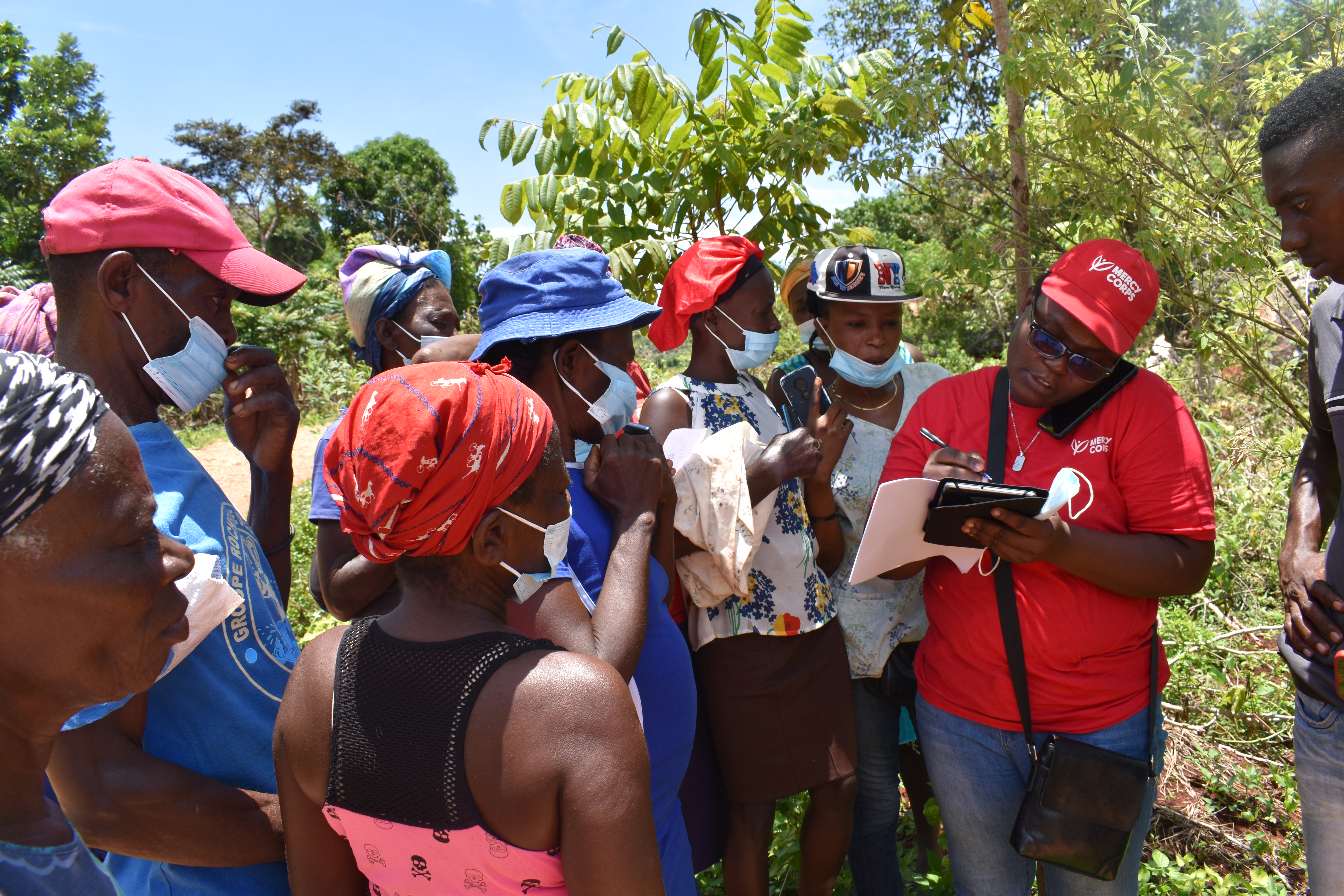
Families in Haiti’s Central Plateau and Lower Artibonite have been going hungry – not because food is not available, but because they cannot afford it.
We know that it will take much more than seven months to get Haiti’s devastated economy to a stage where it can adequately support Haitians – providing the jobs they need to take care of their families. We know that even before the earthquake, these families struggled with food security. And we know that this situation must change.
With support from USAID, Mercy Corps is taking the first step to address the dire situation in the Central Plateau and Lower Artibonite. Families in these areas have generously taken in thousands of people who left Port-au-Prince after the earthquake - adding more mouths to feed when they already struggled.
A $12.5 million grant, under the new Emergency Food Security Program in Haiti, will allow us to provide emergency food aid to families in need – and to support local economies by purchasing the food from nearby markets and vendors. We welcome this new effective and efficient food aid initiative.
Twenty thousand families, or approximately 100,000 people, will benefit from this program. For nine months, we will give them vouchers for monthly supplies of staples like rice, beans, and oil. We estimate that nearly half of the people who receive this food will have been displaced by the earthquake.
One hundred thirty five small businesses will also benefit – providing food staples for these families and earning additional income.
This USAID-funded program is a key element of Mercy Corps’ efforts in these underserved regions of Haiti. Separately, Mercy Corps is also providing emergency income to 20,000 families hosting internally displaced people through cash for work and cash grants. We will also run a voucher program so these families can buy shelter supplies to improve their now-crowded homes, and we will help women buy supplies to start their own small businesses.
Long term, Mercy Corps is working to jumpstart these regional economies through improved agricultural production and small business support – so that families no longer go hungry, because they have the income to buy what they need.
Blog Post: Posted July 18, 2010, 9:40 am by Lisa Hoashi
Taking lessons learned from Nepal to Haiti
Country: Haiti
Topics: Emergencies
In late April of this year, fresh on the job managing Mercy Corps’ cash-for-work program in Port-au-Prince, Kristina Carvonis was asked to go to Nepal. She left her native city, which had been devastated by the 7.0-magnitude January 12 earthquake, to attend a conference in Kathmandu on Disaster Risk Reduction.
Counter-intuitive? For countries like Haiti, which are prone to hurricanes, flooding and earthquakes, there is always more that can be done to help prepare people for emergency.
Kristina shares what she learned in Nepal and how she sees putting it to use in Haiti in the interview below.
Representatives from nine Mercy Corps country programs — including Kristina Carvonis from Haiti (green shirt) — and three headquarters support staff visited the Kalili Risk Reduction program in the Far West of Nepal and attend training sessions on Disaster Risk Reduction from April 25-20, 2010. Photo: Mercy Corps
Tell us more about the Nepal training.
It was a cross visit for Mercy Corps employees from around the world to see the program in Nepal—a Mercy Corps country program that has been very successful in Disaster Risk Reduction. Mercy Corps representatives came from Niger, China, Tajikistan, Indonesia, Georgia, East Timor, Myanmar, Nepal and Haiti.
Over the course of week, we shared with each other the issues that each of us faces in our country, including tsunamis, earthquakes, hurricanes, floods — these were the big ones. The majority of our countries had flooding. We exchanged ideas and techniques for reducing the effects of natural disaster for people living in our countries. And we talked about the effects of climate change as well.
What are some of ways you learned to reduce risk of disaster?
We learned about the Hyogo Framework for Action, a set of humanitarian guidelines for disaster risk reduction that was created in Kobe, Hyogo, Japan in 2005. It gives different steps that need to be implemented by a country or even a village to follow in order to be prepared for a disaster. One step might be to do what’s called a “vulnerability assessment,” which is to survey an area to see what the risks are and better understand what you need to prepare for.
If the evaluation shows that an area is vulnerable to hurricanes or flooding, then you could begin to put an early warning system in place to alert people when a storm is coming and give them instructions about what to do. Here in Haiti, we know that another earthquake is imminent. Unfortunately there’s no early warning for earthquakes. But you can still prepare people for them, and do drills. If there’s an earthquake coming, people need to know that they need to do to secure their homes and their belongings and get enough water.
What was it like to travel to Nepal?
I found it really exciting because in Nepal, the terrain is very similar to Haiti. They have lots of earthquakes, landslides, and floods. The floods come every year. Also, it seemed that the education level in Nepal is similar to what it is in Haiti, and yet in Nepal they were able to teach people a lot about how to take care of themselves in an emergency. I was encouraged, because sometimes in Haiti, we make the excuse that due to low levels of education, we can’t make the changes we need to. But in Nepal, the Mercy Corps team was able to really do a lot.
I noticed everything about the country! The smells, the trees. Like Port-au-Prince, there is noise and horns in the street. But the language is different and the people look different. But the things that were amazing to me was that when we went to villages, I saw that people live in difficult conditions there too, but they’ve been able to make real improvements to their situation. They live in mud houses, but they’ve also been able to come up with an evacuation system in case of flooding. They had built a shelter for the people in the village who were the most vulnerable to flooding, so they didn’t have to go so far from the village when flooding happened. I was amazed. I want to see my Haitian compatriots organize themselves like that.
People in these villages had also learned to save grains for the flood season. They had made sure it was enough for them to either eat or to sell, so that when the floods came they had food or could purchase things. They had collected all these before the floods. The mountains of Nepal have all these rivers that all join into one and that river gets engorged and floods the plain where everyone lives.
What was something that you saw in Nepal that you think would also work in Haiti?
You definitely have to take culture into account when you’re considering whether something will work in a country. In Nepal, they used street skits to educate people on emergency preparedness and teach them about safety. They would act out scenarios before an audience in a village and make it easy to understand and entertaining. Wherever you turn in Haiti, there is art and music — even when Haitians are protesting! I’m sure that we could do the same kind of street skit here in Haiti, using the Haitian love of art and expression to channel educational messages.
I go to the camps here in Port-au-Prince every day. I manage Mercy Corps’ cash for work program here, which employs earthquake survivors in clean-up and rebuilding projects. It gives them income to use to provide for their families and improves camp conditions.
At the camps, I could see us doing Disaster Risk Reduction street skits. You could have a troupe that would go to site to site to do the trainings there. The trainings could be about natural disasters like earthquakes. They could also cover hygiene issues like the importance of washing your hands or avoiding HIV/AIDS. The majority of people haven’t been to school and they haven’t ever had this type of minimal information.
Many people didn’t even know what an earthquake was. Even now, I hear people on the radio saying that the earthquake was a punishment from God. People need to understand the natural causes of an earthquake, and that there are measures that they can take to help themselves during an earthquake, rather than just succumbing to it. Education is key. I recognize that I’ve had the opportunity to have an education. I can go online and research what I need to do to help my family during an earthquake. Many people don’t have that option. But we can help bring that information to them.
How have you started using what you learned in Nepal?
Right now I’m going to camps and speaking with groups of people about what kinds of things are happening in the camp. My goal is to help them link what is happening around them to the effects on their environment. For example, showing them how to properly dispose of garbage so it doesn’t cause health issues for the camp. Or to look at how water is flooding tents and looking at what needs to be done to prevent flooding in that area.
These days the main concerns in the camps are flooding, security and food security. Flooding is big because it’s rainy season and it’s raining every day.
Even before the earthquake flooding was a major problem. Houses in the slums of Port-au-Prince, called bidonville, were built right up on top of each other. They were built in any random place. Some were built even in beds of rivers. Flooding is even worse now, because so many are living in tents.
Education and training are the two most important things I see for Haiti in terms of reducing our vulnerability to disaster. I continue to look for ways to incorporate both of these things into my work.
Kristina Carvonis walks through Carradeux displacement camp with colleagues Claude Augustin (left) and Jean Bernard (right). At this camp, they have given earthquake survivors temporary jobs digging drainage canals, to help prevent the camp from flooding during the rainy season. Photo: Fabiola Coupet/Mercy Corps
Blog Post: Posted July 16, 2010, 10:19 pm by Lisa Hoashi
Photos from a busy day in Port-au-Prince
Country: Haiti
Topics: Emergencies, Displacement
Every day is a busy one for our team here, but today seemed especially so.
This morning, I headed out with Fabiola, our Haiti communications officer, to visit the camp called "MFD" (which stands for "Mobilisation Fraternelle Pour le Developpement"). Here Mercy Corps has given residents temporary clean up and rebuilding jobs. Over the last couple of months, when I've gone to visit sites where we've provided these jobs, the work has been mainly in the camps, digging drainage ditches and making other improvements to help prevent flooding.
Today though, we found hundreds of workers in the hilly, labyrinthine neighborhood outside the camp, digging a series of drainage ditches alongside the unpaved streets; separating trash from rubble so a compacting trash truck could pick it up; and clearing rubble from the sides of roads. I learned that in this area, not everyone lives in tents in the camp, but are scattered around the neighborhood, living in tents in open areas and even on rooftops. Many of the people I talked to were very glad to have the work, it's a source of income that they haven't had since the quake.
Our engineer Jean Bernard was there, overseeing the digging of the ditches and even pitching in with his own pickaxe. He's the one who has designed the plan for this neighborhood's drainage — during the rainy season, rain water pours down the streets and roads become muddy. With these ditches, homes will be better protected and the streets easier to navigate.
I have always loved cities built on hills and, despite it being such a difficult place, Port-au-Prince is no exception. There is something really special about being lost in the narrow streets and in the passageways between houses, that climb up hills, layer upon layer. This was clearly a poor neighborhood, but it too had that magical, peaceful quality of being tucked away from the rest of the busy world.
Next we went to another camp nearby, called Bas Duval. There we met with Gerta Jean, a woman who lives in a house next door to the camp. Gerta has become Mercy Corps' water supplier for the camp.
Each week Mercy Corps hands out vouchers to the camp residents, which they can redeem for water at Gerta's house. Gerta buys water from a company who fills a reservoir in the entry way of her house. Then, at the end of the week, Mercy Corps pays her for all the vouchers redeemed. This way Mercy Corps delivers water in a way that helps create new water vending businesses (like Gerta's) in the neighborhoods where we work. This is the way we're distributing water at 26 of the 28 camps where we work.
Last, I headed over to Le Ecole Internationale de Frere (the Frere International School). There is a tent camp on the grounds of this school that Mercy Corps also serves, and we were doing a distribution today of mosquito nets and wash basins. You'll see here, the Mercy Corps team handing these out to residents, marking their names off a list to make sure everyone gets one.
This woman was waiting for her turn with some kids — I had to take her picture. She's gorgeous!
Blog Post: Posted July 15, 2010, 10:58 am by Lila Wade
Building capacity in Haiti, one community at a time
Country: Haiti
Topics: Governance
"Haiti needs everything," declared Mark L. Schneider, senior vice president of the nonprofit International Crisis Group, during a visit to the Mercy Corps Action Center in Portland last month.
"Most of all," continued Schneider, who by his own count has visited Haiti more than 100 times, "Haiti needs help regaining the capacity to meet its needs independent of outside support."
Even before the earthquake, Haiti was a failed state. Only 15 percent of children went to public schools. The country ranked 13th from the bottom on Transparency International's corruption index. And four out of five residents were classified as poor, with half of those destitute enough to be considered "extremely poor."
The quake weakened Haiti’s already ineffectual government. Nineteen administration buildings collapsed and a quarter of Haiti’s civil servants died. More than 900 police officers were killed or did not return to their jobs.
"Haiti’s government, already weak, does not have the capacity to reconstruct the country," said Schneider. But true disaster recovery includes helping Haiti meet its own needs.
Mercy Corps is responding to Haiti’s need with relief programs designed to help communities become self-reliant.
For example, to supply families in tent camps with water, Mercy Corps encourages the development of local water economies, instead of giving water away.
Mercy Corps staff seek out vendors who already sell water and then make a deal: we’ll purchase large quantities of water, and then distribute vouchers to families, which they can redeem weekly for a portion of that water.
Sure, we could arrange for tankers to deliver water, or erect a pipeline to pump it in. But, after we leave, communities would be left high and dry once more. This way, families receive water, water vendors earn an income, and the local economy creaks into gear. We hope that once we leave, the water enterprises should remain and prosper.
Another capacity-building activity relies on one of Mercy Corps’ core values: letting locals lead. Mercy Corps allows communities to decide which infrastructure-improvement projects, such as road building or clearing away rubble, would be beneficial.
Mercy Corps starts by contacting local leaders, calling a meeting, and offering to fund a project to revitalize the area. Then, the staff leaves and lets the locals hold their own meeting to decide what project they prefer. Through this process, communities learn to cooperate, leaders emerge and an ad hoc decision-making structure is born.
The project that the community selects has the additional benefit of boosting economic activity, in addition to improving local governance.
Reviving Haiti’s economy and nurturing community governments won’t happen overnight, says Schneider. "Still, all I can hope is that we stay the course." He adds, "The Haitian people are desperate to see their lives improve. They are willing to make incredible sacrifices to see that happen -- but first, they need our help."
Blog Post: Posted July 11, 2010, 8:47 am by Lisa Hoashi
Moving forward in Haiti
Country: Haiti
The last few days, the members of Mercy Corps’ youth program team in Haiti have been running around attending to details for Sunday’s launch of Moving Forward, a youth program that uses soccer and other sports to help young people recover physically, socially, mentally, and emotionally from the January earthquake. Moving Forward will reach over 1,500 young people throughout Haiti, and train 50 coaches and educators at 25 community organizations and schools.
Today, Mercy Corps is partnering with the Haitian government, the U.N., and several other organizations to hold an event at the national soccer stadium Stade Sylvio Cater in Port-au-Prince, celebrating youth, sports and Haitian culture on the day of the World Cup final and six months after the earthquake.

We’ll start the morning off with Moving Forward activities for hundreds of kids, and about 25 youth organizations. Kids will play soccer, kickball, Simon Says, and other games. Getting kids to laugh, play, and let go of stress is what Moving Forward is all about.
Then the World Cup final will be screened at 1:00pm – the general public is invited. For the last month the games have been screened here, with support from the U.N. and Haitian government. AOL News reporter Emily Troutman wrote a fun story about the screenings recently.
Then, in the evening, Mercy Corps with our local partner Cinema Under the Stars and the Ministry of Youth, Sport and Civic Action, will bring an evening of remembrance of those lost in the earthquake, and also a celebration of what is possible for Haiti, given the spirit and creativity of its people. There will be performances by lots of Haitian musicians, Haitian comedian Kako, and short films, including those created specially by Sesame Street for Haiti’s kids.
After so much struggle here, it’s amazing to see kids laugh and play. It’s incredible to see people enjoying themselves with their friends and families. We’re hoping to bring a fun, inspiring day tomorrow to thousands of people, many of whom are coming from nearby encampments next to the National Palace, where thousands of tents line the Champs de Mars plaza. You can never forget that when it comes to moving forward, our basic needs as humans include not only for food and water and shelter, but also hope.
Blog Post: Posted July 11, 2010, 8:38 am by Lisa Hoashi
Clearing the rubble in Haiti
Country: Haiti
Topics: Emergencies

It’s my second trip to Haiti, and I’ve been especially vigilant this week in Port-au-Prince to discern signs of progress. I know that people back home will want to know: Is rebuilding happening?
The answer is yes, but incredibly slowly. The city is still a picture of devastation, with crumbled and flattened buildings and huge piles of rubble. But these ruins are now a backdrop to the life that is now resurgent in the country.
The United Nations Development Programme estimates that there is 20 million cubic meters of rubble from the earthquake – it would fill 8,000 Olympic-sized swimming pools.
As I travel through the city, I see workers in the midst of these collapsed buildings, clearing and sorting through rubble. The vast majority of these workers are not sitting behind the controls of heavy machinery though, they are instead bending over in the hot sun, moving rubble with buckets, with gloved hands, chipping away at it with pickaxes. I cannot imagine a more daunting task. But there they are, working by hand. It is what they have.
And then I begin to see evidence all around me of their labors to sort through the rubble and deconstruct the wreckage. I see tangles of salvaged rebar; stacks of gates and other metal works leaned up against walls; planks of wood and scraps of metal piled on the ground. I see at first what seem to be just piles of rock alongside the road, and then I notice how neatly conical the piles are, and then I see that there are rows of three or more piles, each containing a different size rock or cement chunk: fine, medium and coarse. I realize that this has probably been someone’s labor for days.
Across the street from where I am staying, there is a construction site. All day, laborers walk back and forth on the lot carrying buckets, filling them with rock and carrying them out of sight. Then returning again with the buckets empty to fill once more.
Haitians are a determined and entrepreneurial people. I have no doubt that they have the spirit and strength to rebuild their country. They are doing it, stone by stone, with all they have.
Update from Haiti: A Six-Month Report:
Posted July 2, 2010 by Lisa Hoashi
Voices of Hope and Resolve
Country: Haiti
Topics: Emergencies, Displacement
One of the first groups that Mercy Corps assisted in the Central Plateau was displaced students who left Port-au-Prince after their universities collapsed. We gave them temporary cash-for- work employment surveying local families to find out how many displaced people they were hosting and what their needs were.
With the wages they earned, the students bought food and other necessities. Some sent a portion to family members living elsewhere. The students valued the work — as well as what they learned about their country and neighbors in the process.
Moïse Mackendy, 23
“Everyone is suffering. When a host receives a displaced person, both live with a little more difficulty. But at the same time, the hosts are doing it wholeheartedly. Some are selling possessions or livestock to help these people. And they do it with a smile. Before the earthquake I was disappointed with how things were going in Haiti, but now I understand I must take a position and be one of the people who will make Haiti different.”
Cassandra Augustin Georges, 22
“One woman I spoke to said that she lost all three of her kids on January 12. No goodbyes. These kids had been taking care of her by sending money from the city. So now she has nothing, no way to get by. I gave her some of my own money, I was so touched by her situation. The experience changed me. I understand the necessity to do good to others. If I have something more, I must share it.”
Buldrine Pierre, 24
“I came upon several poor farmers who had received a lot of family from Port-au- Prince, but really did not have any means to feed them. The drought is hard. They can’t plant. They can’t find water. It saddens me when I see that people don’t have any way to make a living. Before January 12, I studied agronomy in Port-au-Prince. I hope to help put this land to productive use so it feeds people. I want to be a leader for development in Haiti.”
Update from Haiti: A Six-Month Report:
Posted July 2, 2010 by Lisa Hoashi
Providing a Lifeline
Country: Haiti
Topics: Emergencies
Elianne Lazard supervises her cash-for-work team at the Carradeux camp as they clear a drainage ditch under a glaring sun. Like many other survivors, she is grateful to have work to do together. “We help each other through the day,” says Elianne, 34.
Everyone here is struggling to start over. “Before January 12, we weren’t rich, but we were doing okay,” Elianne says of her family. “Life is very different now. I’ve lost my home and my husband. My five children have lost their father. Sometimes I feel like getting angry, but all we can do is accept the challenges life brings and move forward. We’re still here — we have to be thankful for that.”
Before the quake, Elianne sold foods like canned milk and rice to support her family. Today, her cash-for-work wages will go first toward feeding her children. Then, she says, “The number-one thing I plan to do is to start my small business again. I have to think ahead and somehow make this money grow. It’s the first lifeline I’ve been blessed with since that tragic day. Thank you to everyone who supported Mercy Corps to make this happen.”
Update from Haiti: A Six-Month Report:
Posted July 2, 2010 by Lisa Hoashi
Emergency Relief To Port-au-Prince Camps
Country: Haiti
Topics: Emergencies
Tents fill every open space in Port-au-Prince: public parks, empty lots, even traffic medians. For thousands of earthquake survivors, these crowded camps are the only housing option.
More than 1,500 families live in a camp called Carradeux. “Life is not easy in Carradeux, but people get by any way they can,” says resident Etzer Dumond, 30. “Thousands of us have had to set up camp here because our homes have been destroyed. We’ve lost loved ones, jobs ... and it’s hard to know where to begin.”
Every day, Mercy Corps is working at Carradeux and 27 other camps to improve conditions and offer survivors a way to begin again. In all, we have provided water, hygiene and sanitation services to 22,000 people. We’ve distributed 3,450 hygiene kits, each containing a month’s worth of household cleaning supplies and toiletries. We’re teaching good hygiene practices like hand-washing and treating water so people can stay healthy even in crowded conditions.

Etzer Dumond is one of 1,500 people employed by Mercy Corps' cash-for-work program at Carradeux camp. Photo: Fabiola Coupet/Mercy Corps
For months, our priority has been to help families in the camps prepare for — and survive — Haiti’s rainy season, which began May 1. Our engineers created flood-mitigation plans to protect Carradeux and other camps. Residents continue to work to prevent flooding by digging trenches and building retaining walls through Mercy Corps’ cash-for-work program. Our cash-for-work program gives survivors temporary jobs for four weeks to complete clean-up and infrastructure projects.
“Before we started the cash-for-work program, Carradeux was covered with debris and trash, and had not received much help since January 12,” says Etzer, who has been employed in the program. “We’ve cleaned up debris and covered stagnant puddles that could breed mosquitoes. For better drainage, we cleared out existing ditches and dug new ones. Mercy Corps has helped us create a safer environment for everyone living here, and most importantly they put some money in our pockets to help us get by.”

Clearing rubble is one of the jobs in Mercy Corps' cash-for-work program. Photo: Miguel Samper for Mercy Corps
For many families, cash-for-work has been the first opportunity they’ve had since the earthquake to earn income.
Mercy Corps prefers cash-for-work over traditional emergency distributions because it allows families to make their own decisions about what food and supplies they need. Also, their spending then directly benefits the local economy. Useful work boosts morale in camps and also offers families a reprieve from the daily stress of figuring out how to get their next meal, so they can begin to plan for their future.
Update from Haiti: A Six-Month Report:
Posted June 28, 2010 by Lisa Hoashi
Bringing Help to Haiti’s Rural Economy
Country: Haiti
Topics: Economic Development, Displacement

Photo: Fabiola Coupet/Mercy Corps
An estimated 90,000 earthquake survivors fled Port-au-Prince to Haiti’s Central Plateau. Even before the quake, this was one of the country’s poorest regions. Its agricultural economy has suffered from environmental degradation and poor infrastructure. Many families lack access to a latrine and walk great distances for water.
Yet, following the earthquake, these households opened their doors to homeless friends and family from Port-au-Prince — even, in some cases, to strangers. At times, there is nothing they can offer except a blanket and a spot on the floor.
To ease the hardships in the Central Plateau, Mercy Corps is providing immediate financial assistance through cash-for-work programs for both the displaced earthquake survivors and the families who took them in.
The strategy behind all our activities in the Central Plateau, however, is long- term: To revitalize the rural economy so people can make a living. If there are jobs, people can choose to stay, rather than returning to the crowded conditions in Port-au-Prince.
Mercy Corps is now hiring the first of 20,000 families for cash-for-work projects in Central Plateau. These projects give a member of each household 30 days of employment on a community-selected project geared at improving infrastructure or agricultural production, such as rehabilitating roads, farmland or irrigation. We are also giving cash grants of $128 to 7,000 host families to take care of their urgent needs for food and household supplies.
In the next 12 months, Mercy Corps also plans to provide materials to 10,000 displaced and host families to improve their homes and temporary shelters in the cities of Mirebalais, Hinche and Saint-Marc. Families will receive a voucher they can redeem from local vendors for tools, building supplies, mattresses, or additional cookware. During that time, we also plan to give vouchers to another 5,000 families for supplies that will help them begin a new trade or business, such as sewing machines or beehives.


Like us on Facebook ›
Sign up for email updates ›
Follow us on Twitter ›
Text CORPS